

3Quellen Water Activator
- Handheld device made from CeraActiv ceramic for activating tap water
- Quick, easy and cost-effective
- For at home or to take away
- Water activation through controlled turbulence and contact with minerals
- Water can release gases (e.g. chlorine in tap water)
- Generates clockwise-rotating water (patent pending)
- The taste becomes more natural and smoother – similar to spring water
Water Activator
H 13 cm | Ø 18 cm | 1,1 kg
| Water temperature: 3–40 °C |
| Capacity: unlimited |
| Activation pulse: clockwise |
| Use: Drinking water |
89,90 €
including VAT, plus delivery charges
The water activator can activate tap water quickly, easily and cost-effectively. At home or to take with you.
It’s very simple to use: place the water activator on a glass carafe, pour in tap water, let it run through, and enjoy the activated water.
A fabric sleeve to protect against scratches is included.


CeraAktiv Ceramic
This EM ceramic is only available from us; it was developed by us and is protected by us. CeraAktiv consists of special water-insoluble silicate minerals, crystals, quartz, and feldspar rocks. For processing, we add effective microorganisms to the ceramic mass, which creates the ceramic’s particularly reactive microstructure.
Mode of action
The water activator is made from our unique CeraActiv ceramic. The inside is left rough to maximise the active surface area.
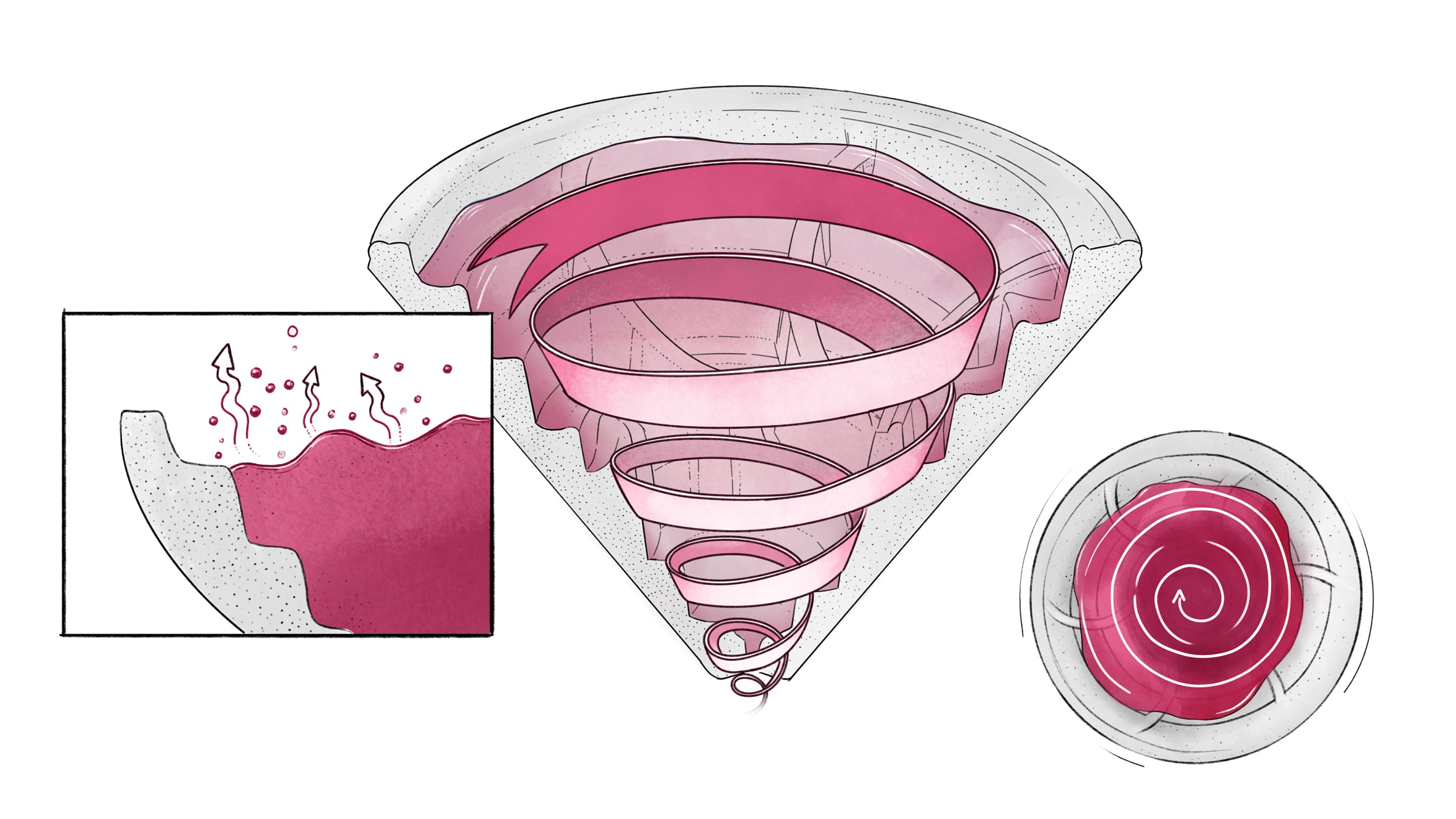
The funnel shape, combined with the helical channel, sets the water in motion in a defined rotational pattern. As it approaches the outlet, the water spins faster and faster, becoming activated.
The internal guide vanes ensure that the water flows out in a clockwise direction. This effect is independent of the direction from which the water is poured. Clockwise-flowing water is regarded as particularly valuable in anthroposophical science, amongst other fields.
When water comes into contact with the CeraActiv ceramic and is subjected to controlled turbulence, any gases dissolved in the water (e.g. chlorine) may be released. This affects the taste and palatability.
As a result, the tap water tastes more natural and smoother, similar to fresh spring water.

Carbonation of activated water
If you wish, you can also carbonate the activated tap water (add CO2). The activation remains intact.
For use with filtered and softened water
If you filter your tap water, you’ll find that it usually tastes flat and bland. The water activator can help with this. Simply run the filtered water through the water activator and then enjoy its natural, fresh taste.
For use with coffee, tea and in cooking
For the full enjoyment of coffee and tea, as well as for cooking, we also recommend using activated water.

Decanting wine with the water activator
It’s not just tap water that benefits from the water activator. You can also decant your wine to perfection, opening up a whole new world of flavours.
We particularly recommend using this with younger, full-bodied red and white wines.

Place the wine aerator on a wine carafe and pour the wine in evenly but quickly.
Contact with the CeraActiv ceramic allows unpleasant odours, such as those caused by sulphur, to escape. The controlled swirling ensures that the wine has optimal contact with oxygen; it ‘breathes’.
The wine develops its natural flavour and full aroma very quickly. You can enjoy it straight away; there is no need to decant it.
Technical / Physical Background
The water activator is a passively operated water flow device designed to provide reproducible flow-induced activation and, where necessary, degassing of tap water.
The water activator allows tap water to be physically influenced in a targeted manner through a defined flow path. Due to the special surface of the silicate-based CeraActiv ceramic, material-induced interactions may occur. This effect may contribute to the release of any gases dissolved in the water.
The starting point for the development was the question of how known effects from fluid mechanics, gas solubility in liquids and interfacial physics could be applied to a compact system that operates independently of the user. The focus was on developing an internal geometry that uses gravity alone to generate a reproducible, directed rotational flow, increases the water’s residence time and, at the same time, maximises the effective contact area between the water and the ceramic.
The scientific challenge here was to achieve the targeted coupling of pressure changes along a funnel-shaped flow channel, locally defined shear forces on structured surfaces, and controlled flow separation to release dissolved gases. The helical channel structure, in combination with curved guide vanes, was developed iteratively to ensure a flow-mechanically stable direction of rotation, independent of the direction of inflow and flow rate variations. In parallel, the outlet geometry was designed to produce a reproducible ratio of flow velocity to contact time.
A patent application has been filed for the water activator.